|
Hledání foto podle linky
Tramvajové provozovny
| • |
MTS - Metro Transportes do Sul, S.A.
Founded on 20.05.2002. Service began on 01.05.2007.
A light rail system operated by the Barraqueiro group, featuring three lines serving parishes within Almada and extending to Corroios in Seixal. Proposed extensions into Seixal, Barreiro, Moita, Montijo, and Alcochete remain unapproved. |
Seznam typů
Nefotografovaná vozidla |
Maps
City Photo Galleries
Building and reconstruction
Informace
|
Information about municipality
|
|---|


|
Almada
Founded: 1190
Area: 70,21km2
Population: 177`268
Almada is a municipality on the southern bank of the Tagus River, forming part of the Lisbon Metropolitan Area. It stretches from the riverfront at Cacilhas to the Atlantic coast at Costa da Caparica. Its geography makes it both a commuter gateway to Lisbon and a seaside destination.
For those interested in transport, Almada is notable for the variety of connections it offers. The Metro Sul do Tejo light rail weaves through its urban districts, while buses provide links between neighborhoods and the beaches. The ferry from Cacilhas to Lisbon’s Cais do Sodré remains one of the most iconic crossings in the region, combining practicality with spectacular views of the river and the city skyline. Fertagus suburban trains cross the 25 de Abril Bridge, a rare case of rail and road sharing the same structure, and provide direct access to Lisbon and Setúbal.
The municipality is divided into parishes such as Almada, Cacilhas, Caparica, Costa da Caparica, Laranjeiro, and Feijó, and includes two cities: Almada itself and Costa da Caparica. With its blend of historic routes, modern systems, and unique river crossings, Almada stands out as a living showcase of metropolitan mobility in Portugal.
Almada is listed separately from the Lisbon Metropolitan Area on this site because the Metro Sul do Tejo light rail network is specific to the municipality. Nevertheless, the system remains an integral part of the region’s public transport and operates in collaboration with Transportes Metropolitanos de Lisboa, ensuring full connectivity across the metropolitan area.
|
|
Tram
|
|---|

Metro Transportes do Sul
Founded May 20th, 2002
Service started May 1st, 2007
www.mts.pt
|
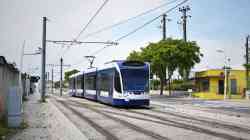
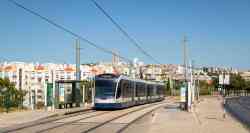
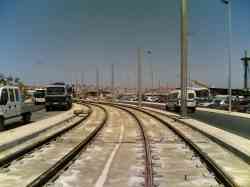
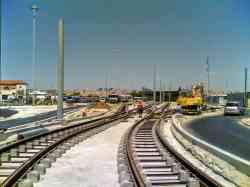
The Metro Sul do Tejo is Almada’s light rail system, built to standard gauge (1435 mm) and electrified at 750 V DC via overhead wire. It covers 13.5 kilometers with three operational lines and extends into the neighboring municipality of Seixal, where it connects Santa Amaro and Corroios stations over 1.4 kilometers. An additional 1.3 kilometers of service track leads to the depot between Corroios and Amora parishes of Seixal municipality.
The origins of rail transit in Almada date back to the 1930s, when proposals for a circular railway led to the construction of the Ramal do Seixal line. This line began in Barreiro and was intended to reach Almada, but poor planning meant it stopped short in Seixal. In the 1950s, the bridge between Barreiro and Seixal collapsed after a collision with a ferry, severely limiting the line’s usefulness. Ultimately, the Ramal do Seixal was dismantled in the 1970s. The foundations for the current light rail system were laid in 1985, and by 1995 an agreement was signed between the Portuguese government and the municipalities of Almada, Seixal, Barreiro, and Moita. Interestingly, the signing took place in Barreiro town hall, a municipality that still remains outside the reach of the Metro Sul do Tejo network even today.
The 1995 project envisioned three branches, which form the basis of the system today: the Cacilhas line, originally planned with two routes but only one constructed; the Pragal/Universidade line; and the Corroios line. The first phase opened in 2007, but several extensions remain unrealized, including the Universidade branch towards Costa da Caparica and Trafaria, and the Corroios branch towards Amora and Foguteiro. A fourth route linking Amora, Seixal, Barreiro, and Moita was also planned but never built.
In 2024, expansion plans gained new momentum. A westward extension towards Costa da Caparica and Trafaria was approved, while proposals for an eastward expansion are under study. The first phase of this eastern project would begin at Corroios, cross Seixal and Barreiro, and terminate at Alhos Vedros in Moita, potentially developed as either light rail or bus rapid transit. A second phase, proposed exclusively as bus rapid transit, would continue from Alhos Vedros through Moita, Montijo, and Alcochete.
|
| Route Nr. | Line name | Route | Notes |
|---|
| 1 | Blue line | Cacilhas ⇄ Corroios | TThe 1995 plan included an alternative route from Cacilhas to Parque da Paz, with a future extension envisioned towards Foguteiro. |
| 2 | Yellow line | Corroios ⇄ Pragal | This line follows the original 1995 design, though the planned extension to Amora was never realized. |
| 3 | Green line | Cacilhas ⇄ Universidade | An alternative route between Almada and Pragal was also proposed in 1995, with extensions to Costa da Caparica and Trafaria later approved in 2024. |
|
|
Electric buses
|
|---|

Carris Metropolitana
Founded April 1st, 2022
www.carrismetropolitana.pt

Transportes Sul do Tejo
Founded January 25th, 1995

Alsa Todi
Founded November 5th, 2020
|
Carris Metropolitana operates under Transportes Metropolitanos de Lisboa, coordinating bus services across the Lisbon metropolitan area. Almada belongs to Area 3, which covers the southwest sector including Almada, Barreiro, Seixal, and Sesimbra. Services here are managed by Transportes Sul do Tejo (TST), based in Almada.
TST plays a central role in the network and joined the electrification effort in 2025 with the acquisition of 27 Higer KLQ6125GEV3 electric buses, now in active service across southern routes. A further 16 Higer buses are scheduled for delivery in the first quarter of 2026, strengthening the fleet and advancing the transition toward sustainable mobility.
On the site, TST is listed under the Lisbon Metropolitan Area page, reflecting the fact that it provides services not only for Almada but for the entire Area 3 of the system. Area 3 is also tightly linked with Area 4, operated by Alsa Todi, and maintains strong commuter connections directly into Lisbon, making it one of the most integrated sectors of the metropolitan transport framework.
Carris Metropolitana’s route numbering system makes it easy to identify services in Almada. Routes beginning with the digit 3 belong to Area 3. The second digit indicates the type of service: numbers 0 to 4 designate intermunicipal routes within the area, 5 marks routes connecting adjacent municipalities, while 7 and 8 identify commuter services running directly into Lisbon. The final two digits serve as unique identifiers, often preserving historical references from the pre-Carris Metropolitana era. For example, route 3501 is an Area 3 service between adjacent municipalities.
Together, these elements highlight Almada’s position as a key hub in the metropolitan transport system, with TST ensuring both local coverage and strong commuter links to Lisbon, while gradually expanding the share of zero-emission vehicles in daily service.
|
|
Last updated 06th November 2025.
|
|
|
Náhodné foto
|


 Elektrická Městská Doprava